Data Hub
Status: stable. The Data Hub is read-only, has no side effects, and never touches your broker. A fresh install reads market data through it without a single API key configured.
Most market-data providers gate the good stuff behind an account: FRED needs a key, FMP needs a key, EIA and BLS need keys. That's a lot of sign-ups before OpenAlice can show you a macro dashboard. The Data Hub removes that wall.
The Hub (hosted at https://traderhub.openalice.ai) is a thin, hosted relay for low-frequency market data — macro series, calendars, sector boards, fundamentals. OpenAlice ships pointed at it, so the moment you start the app the reference boards populate, zero keys required. Your own provider keys remain the fallback path; the Hub is a convenience layer, never a correctness dependency.
The resolution chain
Every Hub-backed read resolves in a fixed, explicit order:
hub → your own provider key → loud error
- Hub — if
hub.enabled(the default) and the Hub is reachable, serve from it. - Your key — if the Hub is off, down, or doesn't cover that dataset, fall back to your own provider key (from
market-data.jsonor the globalprovider-keys.json). - Loud error — if neither path can serve it, OpenAlice raises an explicit error. It never silently returns empty.
Turn the Hub off (Settings › Market Data, or hub.enabled: false) and behavior collapses to exactly the bring-your-own-keys model — same tools, same shapes, just sourced from your own accounts.
The Hub is a convenience, not a lock-in. Point
hub.baseUrlat a self-hosted relay, or switch it off entirely and supply your own keys. K-lines and quotes deliberately stay off the Hub — realtime data comes from your broker (via UTA) or your vendor, where freshness incentives actually live. Live K-line/quote vendors are now a toggleable picker (Chart Vendors) — see Symbol Search — distinct from the Hub's low-frequency provider keys. The Hub only ever serves shape-checked data, never configuration.
Origin & staleness — never silent
Every Hub-aware payload carries a meta envelope so you always know where the number came from and how fresh it is:
meta field | Meaning |
|---|---|
provider | The upstream source (yfinance, fred, fred+bls+eia, …) |
asOf | When the payload was assembled |
cachedAt | Set when served from cache (in-process or the Hub) |
origin | hub (served by TraderHub) or local (built from your own keys) |
stale | true when an upstream refresh failed and this is the last-good copy |
In the Web UI these surface as small hub / local / stale badges on each board. A stale badge means "the source didn't refresh, you're looking at the last good copy" — explicit, never hidden.
Reference boards
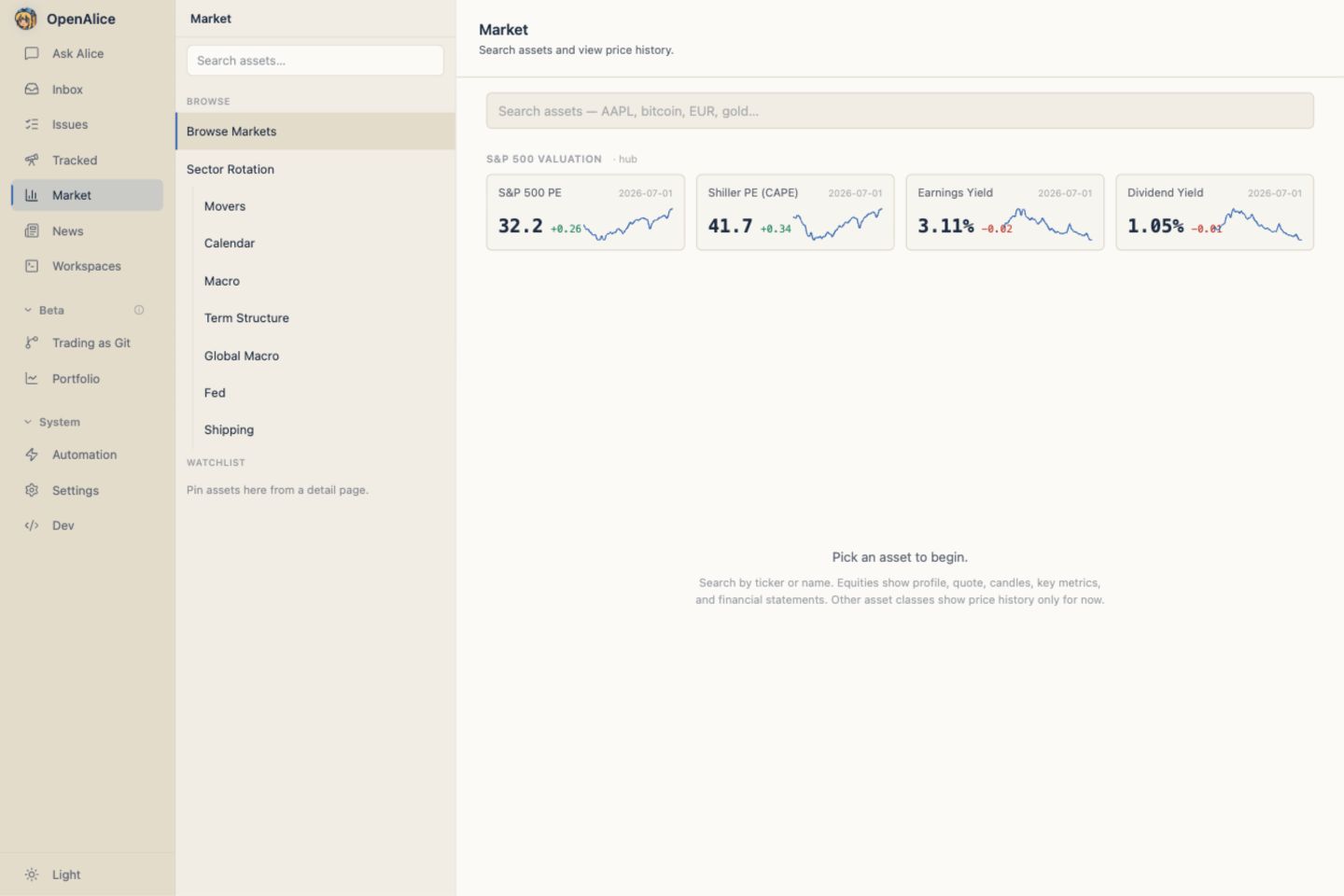
The Hub serves nine curated boards — single-call, top-of-funnel reads, each its own cross-section of the market. All of them come through one tool, marketGetBoard (the rotation board has its own dedicated sectorRotation tool), the route GET /api/reference/{board}, and the traderhub board get --board <name> CLI command.
| Board | What it carries | Source | Refresh |
|---|---|---|---|
| movers | Gainers / losers / most-active + Yahoo screeners (undervalued growth, growth tech, small caps, undervalued large) | yfinance | ~60s |
| calendar | Earnings, IPOs, ex-dividend (default 14-day window) | FMP | ~30m |
| macro | 14 curated FRED series — Fed funds, 2y/10y, 10y–2y spread, unemployment, jobless claims, WTI, dollar index, payrolls, M2, sentiment, breakeven, CPI YoY | FRED | ~30m |
| fed | H.4.1 balance sheet (assets, Treasuries, MBS), primary-dealer net positions, FOMC documents | FRED + NY Fed + federalreserve.gov | ~60m |
| valuation | S&P 500 strip — PE, Shiller CAPE, earnings yield, dividend yield (5y history) | multpl.com | ~6h |
| global-macro | 7 countries × 5 indicators (CPI YoY, short rate, leading indicator, house prices, share prices) | OECD | ~6h |
| shipping | 6 maritime chokepoints (Suez, Panama, Hormuz, Malacca, Bab el-Mandeb, Cape of Good Hope) — daily tonnage + vessel counts | IMF PortWatch | ~6h |
| term-structure | BTC/ETH futures curve with perpetual anchor + annualized basis | Deribit | ~120s |
| rotation | GICS-11 sector ETF cross-section vs SPY — see Sector Rotation | yfinance | on demand |
Each board is independently breaker-protected: a transport failure on one board trips a short (~60s) per-board breaker and falls back to local, while its siblings keep serving from the Hub. One bad board never cascades.
You: Show me the macro board.

Alice: [calls marketGetBoard(board="macro")]
       Fed funds 5.33 · 10y 4.21 · 10y–2y −0.38 (inverted)
       Unemployment 4.1 · WTI 78.40 · M2 …
       origin: hub · asOf 2 min ago
Provider keys — local and global
When you do bring your own keys (to bypass the Hub, or to cover a dataset it doesn't relay), there are two places they live:
- Per-install —
market-data.json→providerKeys. Scoped to this checkout. - User-global —
~/.openalice/provider-keys.json. Shared across every checkout and the desktop app on this machine.
They merge local-wins: the global file fills gaps, an explicit per-install key overrides it for that provider. Covered keys: fred, fmp, eia, bls, nasdaq, tradingeconomics, econdb, intrinio, benzinga, tiingo, biztoc.
For the keyed economic sources (FRED / EIA / BLS), a missing key doesn't break the board — OpenAlice routes the request through the Hub's keyed proxy instead, which supplies its own key. Drop your own key in and it takes over immediately.
No more OpenBB sidecar. Earlier versions could point market data at an external
openbb-apibackend (a separate Python server). That backend is gone — market data now runs entirely in-process through the SDK, with the Hub as the zero-key relay on top. There's nothing to stand up alongside OpenAlice.
On the CLI
Inside a workspace, the boards and fundamentals are a dedicated CLI away — traderhub:
traderhub board get --board macro
traderhub board get --board calendar --days 14
traderhub board rotation
traderhub equity profile --symbol NVDA
traderhub economy fred-series --series-id DGS10
traderhub groups the whole low-frequency surface: board, equity, etf, economy, global, shipping, fed, crypto, index. It's TraderHub-first throughout — same resolution chain as the tools. See MCP & CLI Access.
Configuration
The Hub is configured in ~/.openalice/data/config/market-data.json:
{
  "hub": {
    "enabled": true,
    "baseUrl": "https://traderhub.openalice.ai"
  },
  "providers": { "equity": "yfinance", "crypto": "yfinance", "currency": "yfinance", "commodity": "yfinance" },
  "extraVendors": [],
  "providerKeys": {}
}
| Field | Description |
|---|---|
hub.enabled | Master switch. false = bring-your-own-keys only, no Hub calls |
hub.baseUrl | The Hub endpoint. Point at a self-hosted relay to keep the zero-key model on your own infra |
providers | Default vendor per asset class (the fallback path) |
extraVendors | Opt-in incremental equity vendors federated into search (e.g. eastmoney, twse) — additive, never a replacement; toggled via setMarketVendor / the Chart Vendors UI |
providerKeys | Per-install vendor keys; merge with the global provider-keys.json |
See the full schema in the Configuration Reference.
Next Steps
- FX Workbench — Combine currency bars with macro divergence and indicative carry.
- Symbol Search — See how vendor symbols and broker contracts differ.
- Equity Research — Use the zero-key research tools.
- Technical Analysis — Feed Hub and broker bars into quant scripts.
- Configuration Reference — Tune Hub and provider-key settings.